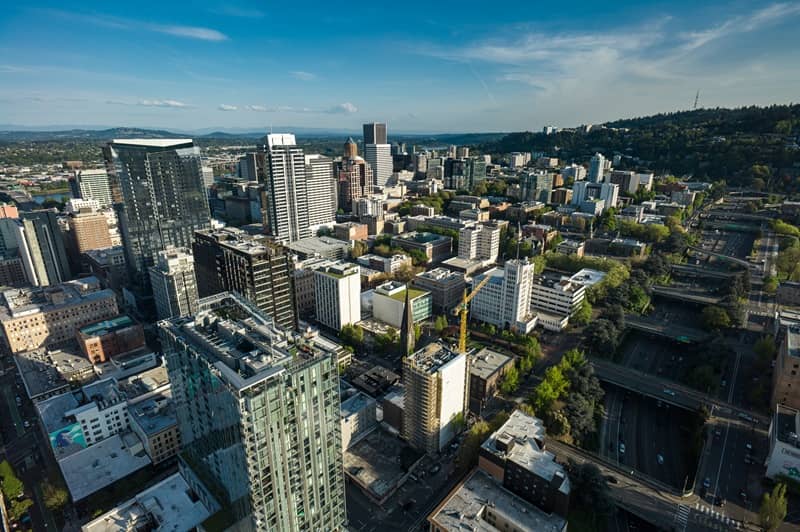
The Oregon Museum of No Business and Industry
By John A. Charles, Jr.
This essay first appeared in the November 2025 edition of Oregon Transformation newsletter, a project of Third Century Solutions. It was reprinted in the Yamhill County News Register on November 26, 2025.
Many years ago, I was in New York City touring an art museum when my 9-year-old son reached out to touch one of the exhibits. A security guard quickly deflected his hand and reminded him that the exhibits were for viewing, not touching. I’ve often thought of that when analyzing Oregon’s economy.
Oregon is the sixth-largest state in the country, but only 1.5% of its land is urbanized. More than half is in federal ownership, which means no development. Most private land is zoned for exclusive farm or forest use, making it off-limits to housing, retail or commercial development. In other words, Oregon is a museum where you can look but not touch.
When this vision was adopted as statewide land-use policy in 1973 by the Oregon Legislature, it probably seemed reasonable.
The apocalyptic book “Limits to Growth” had just been published, predicting dire shortages of oil, copper and other key resources. It was common for environmental pundits to predict, “If we continue growing exponentially, we’ll need eight more Earths.”
President Jimmy Carter established The Global 2000 Report to the President, whose members sought policy reforms to address the predicted resource shortages by the year 2000. My boss at the time was CEO of the New York-based Environmental Defense Fund, a prominent environmental litigation group, and he was an advisor to The Global Report 2000.
I used to open the heavy manila envelopes that arrived periodically from the White House in advance of commission meetings. The briefing papers were filled with predictions of doom.
But the forecasts turned out to be wrong. Resources actually became more abundant, because entrepreneurs continually developed more efficient ways to find and process them.
Economist Julian Simon made a public bet in 1980 with doomster biologist Paul Ehrlich, author of “The Population Bomb,” that five metals — copper, chromium, nickel, tin and tungsten — would decline in price over a 10-year period. Ehrlich predicted shortages would cause prices to rise.
Simon won the bet, but news of that apparently never reached Oregon. Policymakers here continued to fear economic development, deciding most land and water should be preserved for the future.
Not future use. Just preserved, like a museum.
All across the state, efforts to modestly expand urbanization have been met with opposition based on Oregon’s no-growth planning system. Cities have found it impossible to annex needed land for residential, commercial or industrial use.
A plan to extend the runway at the Aurora Airport was halted because it was adjacent to farmland. A proposed renewable fuels depot on the Columbia River near Clatskanie was delayed by land-use litigation. And there is a chronic housing shortage in Central Oregon because of zoning restrictions.
Since 2007, mandatory decarbonization of the economy has emerged as another trump card to kill economic growth, thanks to legislative policy. Almost any proposed construction project can be challenged on the basis of greenhouse gas emissions.
One state agency by itself, the Oregon Department of Environmental Quality, operates two carbon rationing programs expressly designed to make fossil fuels scarce.
Under the watchful eye of state planners, Oregon has become the state that doesn’t build. Thus, we have a shortage of electricity, highways, land and housing — problems that are self-inflicted.
Fortunately, some business leaders seem willing to confront the truth.
Ahead of the annual conference of the Oregon Business Plan, set for Dec. 8 in Portland, economist John Tapogna has put together a presentation titled “Oregon’s Choice: Grow Modestly or Not at All,” which challenges much of the conventional policy wisdom. His slides document a number of concerning trends:
Declining birth rates and a shrinking population; high and growing tax burdens; unsustainable costs associated with PERS; land shortages and high housing prices; and excessive business regulation.
Oregon Business Plan conferences are usually characterized by polite mingling and bland speeches. This one might be different.
The final slide of Mr. Tapogna’s presentation states: “If we fail to adapt, we risk locking ourselves into a future of stagnation, scarcity and decline. Yet, this is still a choice.”
Polite mingling isn’t good enough anymore.