An Unlikely Path, A Lasting Legacy: John Charles’ Cascade Story
By Naomi Inman
From quiet beginnings to enduring influence in Oregon’s policy landscape
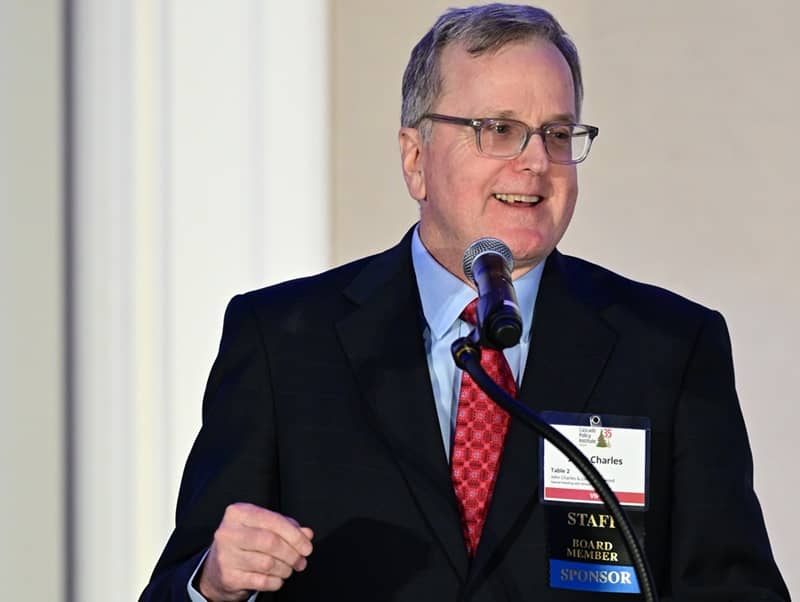
When John Charles took the stage at Cascade’s 35th Anniversary Dinner, he told a story that surprised many in the room. “You might imagine,” he began, “that if I’m the president and CEO of Cascade Policy Institute for 21 years… there was some logical progression to my life… And that’s actually not true at all.” Nothing about his path, he admitted, was linear, planned, or predictable.
In 1991, as Cascade was getting started, John was in his 11th year running the Oregon Environmental Council. “It was a slightly different organization with different priorities,” he noted wryly.
He traced his early years in the environmental movement, from high school through more than a decade of his career and described watching that movement change. “The movement had become very dictatorial… very mean… and much more interested in the environmental bureaucracy than they were the environment.”
“That wasn’t what I signed up for,” he said. “I saw so many cases where people’s lives were… wrecked by environmental regulation. And the people doing it, I think, really just did it because they could; it was sport.” By the early 1990s, he wanted out. He just didn’t know where to go next.
John’s first Cascade event featured José Piñera, architect of Chile’s private pension system. He came back to hear Ted Kolderie of Minneapolis make the case for charter schools, and Marshall Fritz of the Separation of School and State Alliance. “I was just some guy who paid 25 bucks to go to a lunch. No one knew me.”
Those lunches lit a spark. Charter schools, private retirement accounts, freeing education from government monopoly: the ideas drew him in, and Cascade began to reshape the course of his life.
In 1996, he entered Cascade’s Better Government Competition with a concept paper urging Oregon to sell underperforming Common School Trust Lands and invest the proceeds for students. The paper was named a winner, and that recognition opened a door. Soon after, while John was between jobs and “tweaking” his paper in Cascade’s office, co-founder Steve Buckstein asked if he’d like to work on free-market environmentalism. John said yes, mostly because, as he joked, “the modest compensation was a big increase from zero.”
He showed up on his first day to find “no office… no desk, no computer, no email, and no business card. Aside from that it was great!” What he did find was freedom. Steve’s laissez-faire leadership allowed John to invent his own role, follow ideas wherever they led, and build a body of work that eventually made him Cascade’s CEO—a position he has held for 21 years.
“I’ve now been at Cascade 30 years and they changed my life,” he reflected with humor and gratitude. He honored the founders, Bill Udy, Dave Gore, and Steve Buckstein, who laid the foundation. He described the long game Cascade has played from the start, often against the prevailing winds of Oregon politics. And he spoke with conviction about the organization’s long-held warnings: “The things that Cascade has been saying for 30 years will be shown to be correct. So you have to play the long game.”
“I remain very passionate about the future of Cascade,” he concluded. “The work we do matters to people. We’re changing lives one at a time and I’m one of them, and I’m thankful to everybody who put that together.”
Naomi Inman is External Relations Manager at Cascade Policy Institute, Oregon’s free market public policy research organization. As a staff journalist and writer, Naomi helps Cascade make the case for free-market policies through media affairs and publications.
John A. Charles, Jr. is President and CEO of Cascade Policy Institute, Oregon’s free market public policy research organization. He researches, writes, and presents testimony and analysis on state and local issues important to the freedom and opportunity of all Oregonians.