
Portland’s War on Cars 4: A Smarter Automobile Strategy to End Gridlock
by Randal O’Toole
Portland and Metro are losing their war on the automobile. The war began around 1982, when the region’s leaders decided not to build more freeways after the completion of I-205 in the hope that people would drive less if they didn’t have more roads to drive on.
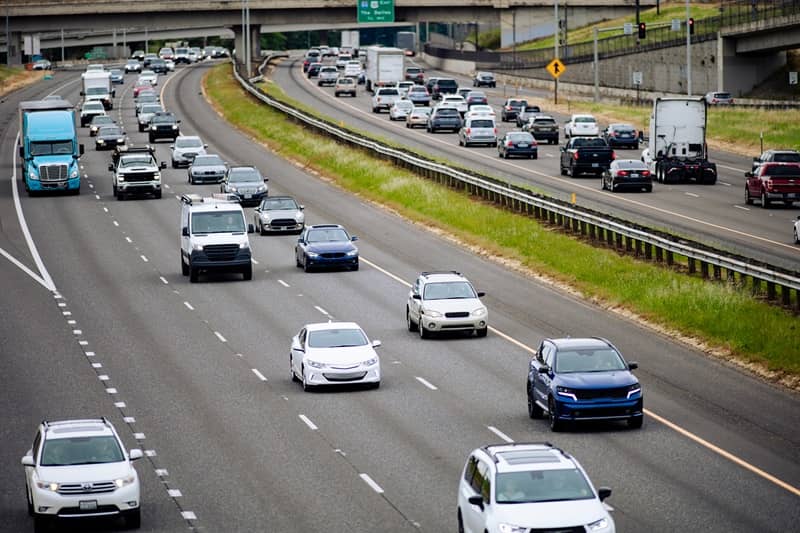
Thanks to the no-more-freeways policy, the amount of time the average Portland-area commuter wastes sitting in traffic has tripled since 1982 and the amount of fuel wasted in congestion has sextupled, generating 250,000 tons of additional greenhouse gases each year.
Despite congestion, driving has more than doubled and per capita driving has grown by 16 percent since 1982. In 2024, the Portland area’s share of commuters driving alone to work was the highest it has ever been.
To give people an alternative to driving, Portland spent billions on light rail, streetcars, and commuter rail. Yet the number of transit trips taken by the average resident has fallen by 16 percent since 1982. In 2024, only 3.8 percent of workers in the Portland urban area commuted by transit, down from 9.6 percent in 1980.
Portland is turning traffic lanes on major streets such as Foster Road and 82nd Avenue into exclusive bus lanes. Lanes that once carried up to 1,000 automobiles per hour will be dedicated to a handful of buses per hour. This is a waste of space.
Portland has also installed bike lanes on many streets, sometimes by reducing the number of automobile lanes, protecting bicycle riders from being hit from behind by automobiles. But most bicycle fatalities take place at intersections, where bike lanes disappear. The annual number of bicycle fatalities in the city of Portland has almost tripled since the early 2010s, mostly due to increased accidents at intersections.
Despite new bike lanes, cycling apparently peaked in 2014. Since then, the number of Portland-area workers commuting by bicycle fell by more than 40 percent while the number driving alone to work increased by 5 percent.
There are good reasons why well over 95 percent of passenger travel in the Portland area is by automobile. Autos give people access to higher-paying jobs, lower-cost consumer goods, better housing, and recreation and social opportunities that are denied to people dependent on slower forms of transportation.
The convenience and economy of automobiles democratized mobility. Before Henry Ford’s mass-produced cars, only the wealthy were truly mobile. Black auto ownership enabled the civil rights movement and the rise of two-car families fueled the women’s rights movement. Low-income Portlanders understand this and are just as likely to get to work by automobile as high-income ones.
Admittedly, automobiles were a problem in the 1970s, when traffic accidents killed up to 55,000 people per year, the average car got only 13 miles per gallon, and motor vehicles spewed so much pollution that Mount Hood was often invisible from Portland on sunny days. Today, automotive air pollution has declined by nearly 90 percent, fuel economies have nearly doubled, and 2025 highway fatalities were 30 percent lower than 1970.
None of these improvements resulted from efforts to reduce driving. Instead, Americans drive three times as many miles today as they did in 1970. In fact, attempts by cities to reduce driving by not building more roads made solving these problems even more difficult as cars waste fuel, pollute more, and are involved in more accidents in congested traffic.
If Portland and Metro truly care about the future of the region, they will end the war on the automobile and adopt policies that increase mobility and allow people to safely, efficiently, and quickly reach their economic, social, and other destinations. Here are four ways to do so:
1. Add high-occupancy toll lanes to all the region’s freeways and manage them so that they will never get congested. Uncongested freeway lanes can move twice as many vehicles per hour as congested ones, so keeping the new lanes uncongested will give people more economic opportunities and reduce congestion on the existing lanes as well by attracting vehicles off those lanes.
2. Develop a data-driven safety program that fixes actual traffic safety hazards rather than relies on slogans and generic policies such as reduced speed limits.
3. Improve regional equity by offering low-interest loans to help low-income people buy electric or otherwise fuel-efficient automobiles.
4. Redesign TriMet’s route map. TriMet works for people going to or from downtown Portland but almost completely fails people going anywhere else. TriMet should design a system that serves other important economic centers as well as it currently serves downtown.
Automobiles are wonderful tools that greatly improve people’s lives. If there are problems associated with them, the solution is not to try to discourage driving but to promote automobiles and roads that are cleaner, safer, and more fuel efficient. That should be Portland and Metro’s goal.
Read the full report, The Portland Transportation Disaster.
All numbers cited in this commentary are from or calculated from the U.S. Department of Transportation, Department of Energy, or Census Bureau data. For more information, see O’Toole’s full report, The Portland Transportation Disaster.
Editor’s note: This is part 4 in a series “Portland’s War on Cars” from a new report by the Cascade Policy Institute, The Portland Transportation Disaster: The High Cost of Anti Auto Planning in Portland. Read the recent commentaries: “Portland’s War on Cars 1 : Losing the War on the Automobile;” “Portland’s War on Cars 2 : Ignoring the Benefits of Automobiles;” “Portland’s War on Cars 3: Ending the War on Automobiles.”
Randal O’Toole is an Adjunct Scholar at Cascade Policy Institute, Oregon’s free market public policy research organization. He is a transportation and land-use policy analyst and the author of several books, including American Nightmare: How Government Undermines the Dream of Homeownership and Romance of the Rails: Why the Passenger Trains We Love Are Not the Transportation We Need. He writes from Central Oregon.
Comments 1
Comments are closed.


Donna Bleiler
The worse auto traffic gets in Portland, the more they punish the rest of the state for their poor decisions. It seems Portland’s intent is to unload more greenhouse gas so the governor can screw the rest of the state with lower emission policies. It’s all about controlling us, and it won’t stop until we vote them out.